

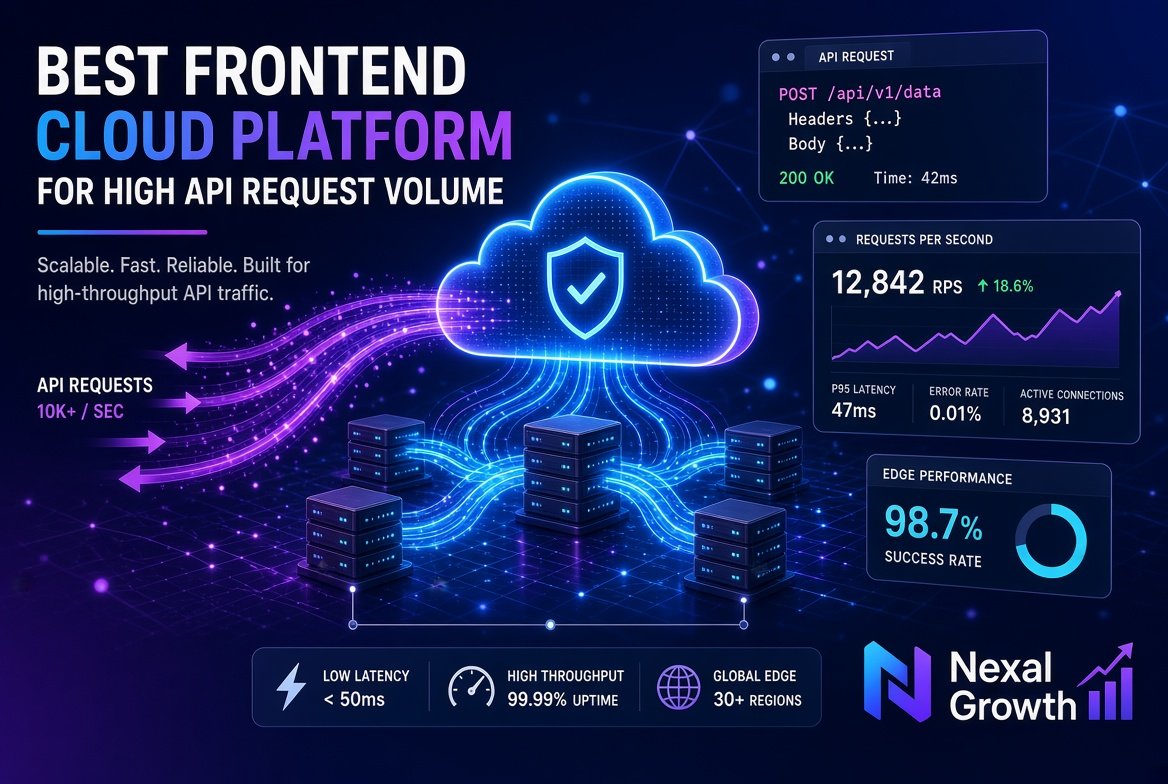
What the Best Frontend Cloud Platform for High API Request Volume?
Finding the best frontend cloud platform for high API request volume requires balancing edge computing power, global content delivery, and robust backend-for-frontend (BFF) handling to protect conversion metrics and user experience.
The Core Architecture Challenge: Managing Massive API Concurrency
When high-ticket B2B platforms, global e-commerce environments, and high-frequency SaaS applications scale, their primary operational bottleneck shifts from static asset delivery to dynamic API request handling. Traditional hosting environments collapse under sudden spikes in concurrency, introducing latency that directly depresses conversion rates, increases customer acquisition cost (CAC), and degrades return on ad spend (ROAS).
Modern engineering and growth teams cannot rely on legacy server configurations. To maintain sub-50ms Time to First Byte (TTFB) and secure enterprise-grade reliability, platforms must utilize distributed edge networks capable of routing, caching, and accelerating millions of synchronous calls without dropping packets or hitting restrictive rate limits.
Evaluating Leading Frontend Cloud Platforms for High-Volume Data
Selecting an infrastructure tier demands rigorous analysis of edge execution limits, serverless function timeouts, pricing predictability, and integration fluidity. The table below contrasts traditional server architectures with modern edge-optimized cloud frameworks.
| Performance Metric | Legacy Monolithic Hosting | Traditional CDN + Origin Server | Modern Edge-Optimized Cloud Platform |
| Global Latency (TTFB) | 250ms – 600ms+ | 100ms – 200ms | Under 45ms Worldwide |
| API Concurrency Handling | Severe bottleneck under load | Prone to origin timeouts | Distributed edge scaling |
| Cache Hit Ratio Efficiency | Low (Static caching only) | Moderate (Standard edge rules) | Advanced programmatic caching |
| Infrastructure Overhead | High (Manual scaling/DevOps) | Medium (Complex cache invalidation) | Low (Fully serverless/auto-scaling) |
Key Technical Criteria for High-Concurrency Frontends
- Edge Compute Capabilities: Offloading API proxying, token validation, and personalization to the edge reduces round-trip times to the origin server, preserving server health during traffic surges.
- Seamless Serverless Integration: Platforms that natively bridge static UI generation with serverless execution environments prevent cold-start bottlenecks during heavy data fetches.
- Bandwidth and Request Cost Predictability: High API volumes can trigger unexpected egress fees. Scalable platforms utilize transparent, usage-tiered models that protect operational margins.
People Also Ask (PAA)
How does high API request volume impact overall website conversion rates?
Unmanaged API latency directly spikes bounce rates. Research demonstrates that every 100ms delay in load time or API response drops conversion efficiency by up to 7%. Ensuring high-speed edge delivery protects user engagement and maximizes marketing ROI.
Should we use serverless functions or dedicated containers for high-volume frontend APIs?
For bursty, unpredictable global traffic, serverless edge functions provide automatic horizontal scaling without idle server costs. However, predictable, ultra-heavy payloads often benefit from dedicated containerized microservices managed via enterprise gateways.
What is the typical timeline for migrating a high-traffic frontend to an edge cloud architecture?
A comprehensive migration and optimization cycle typically spans 4 to 8 weeks. This includes architectural mapping, edge caching rule configuration, load testing under simulated high-concurrency stress, and phased DNS cutovers to guarantee zero downtime.
Scale Your Digital Infrastructure with Nexal Growth
High-traffic digital properties demand more than basic hosting—they require an end-to-end growth and technical strategy that aligns infrastructure performance with bottom-line revenue goals.
Ready to eliminate latency, bulletproof your API workflows, and maximize your conversion efficiency?



0 Comments
Leave a reply