

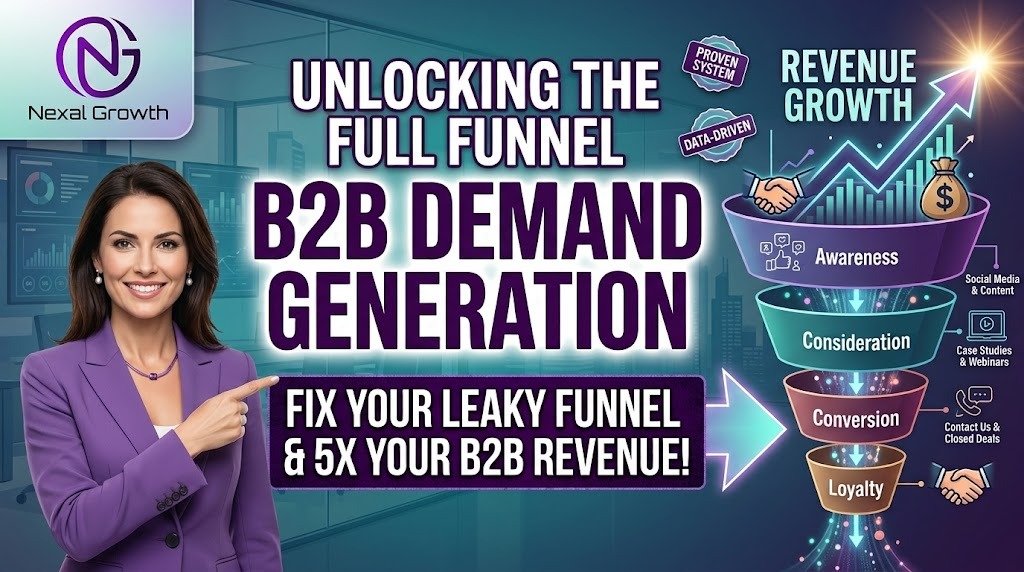
Full Funnel B2B Demand Generation Strategy: Win More Deals Now
A modern full funnel B2B demand generation strategy connects marketing efforts directly to closed-won revenue, rather than stopping at MQLs (Marketing Qualified Leads). B2B buying cycles now take longer and involve multiple stakeholders. Relying solely on gated ebooks to fill your CRM results in low-intent prospects and frustrated sales teams.
Today, B2B buyers complete up to 70% of their research independently before ever contacting sales. This research happens in “dark social“—private communities, Slack channels, and podcasts where traditional tracking software cannot reach.
To win these buyers, you must shift your focus from simply harvesting emails to actively creating demand, capturing high intent, and accelerating the pipeline. At NexalGrowth, we build this exact revenue-focused framework for tech and service companies to align marketing with sales.
Understanding this shift requires a complete change in how you view the buyer’s journey. Let’s break down exactly how to structure your strategy to drive actual pipeline.
The Difference Between Creating Demand and Capturing Demand
Most B2B companies fail because they spend their entire budget trying to capture demand, completely ignoring demand creation. Research shows that only 5% of your total addressable market is actively looking to buy at any given time. The other 95% still needs your solution, but they require education first.
Here is how the two concepts differ in execution:
| Feature | Creating Demand (Top of Funnel) | Capturing Demand (Bottom of Funnel) |
| Primary Goal | Educate the market on a problem they didn’t know they had. | Position your brand in front of buyers actively searching for a solution. |
| Target Audience | The 95% of the market not currently buying. | The 5% of the market actively researching vendors. |
| Key Channels | LinkedIn organic, podcasts, un-gated industry research. | High-intent SEO, paid search, review directories (G2, Capterra). |
| Measurement | Qualitative feedback, direct traffic, branded search volume. | Cost per acquisition, pipeline generated, closed-won revenue. |
Focusing only on the 5% means you are fighting a brutal price war with your competitors. A full-funnel approach ensures you win the 95% before they even start searching.
3 Stages of a Winning Full-Funnel B2B Demand Generation Strategy
Once you understand the difference between creating and capturing demand, you can build a systematic engine. A successful strategy requires focused action across three distinct stages.
Stage 1: Brand Awareness & Demand Creation (TOFU)
Your goal here is to target the entire buying committee, not just a single persona. A CFO cares about ROI, while an end-user cares about usability. You must create content that speaks to all of them.
- Actionable Tactic: Distribute un-gated, high-value insights natively on social platforms. Stop forcing users to leave LinkedIn to read your blog. Give them the value immediately in the feed.
- Channels: LinkedIn organic posts, subject matter expert interviews, and Generative Engine Optimization (GEO) to ensure your brand appears in AI search overviews.
- Problem Solved: This keeps your brand top-of-mind. When the prospect finally enters a buying cycle, they already trust your expertise.
Stage 2: Intent-Driven Demand Capture (MOFU)
When a prospect moves from education to evaluation, your strategy must pivot to capture that intent. This is where data becomes your most valuable asset.
- Actionable Tactic: Use intent data tools like Leadfeeder or 6sense to identify which companies are visiting your high-value pages. Combine this with signal-driven outreach based on recent funding rounds or hiring trends.
- Channels: Deploy retargeting ads strictly to accounts showing intent. Publish high-intent SEO content, such as “competitor alternatives” or “pricing” pages.
- Problem Solved: This stops your marketing team from wasting ad spend on cold accounts that have zero intention of buying.
Stage 3: Pipeline Acceleration & Sales Alignment (BOFU)
Marketing does not stop when a lead books a meeting. A full-funnel strategy requires marketing to help sales close the deal faster.
- Actionable Tactic: Run highly targeted Account-based marketing (ABM) sprints. Marketing must supply sales with bottom-of-funnel assets like ROI calculators, competitor battle cards, and highly specific case studies.
- Problem Solved: This fixes the classic B2B disconnect. Marketing stops blaming sales for failing to close, and sales stops blaming marketing for providing weak leads.
Core Infrastructure: What You Need Before Launching Campaigns
Executing these three stages successfully requires a solid technical foundation. Launching campaigns without this infrastructure leads to disjointed tracking and wasted budget.
First, you must nail your Ideal Customer Profile (ICP). Basic demographics are no longer enough. You need to map out firmographics (company size, revenue) and technographics (what software they currently use). This dictates your entire messaging strategy.
Next, prioritize CRM and RevOps alignment. Your HubSpot or Salesforce setup must accurately track the buyer’s journey across multiple touchpoints. If your tracking breaks between marketing and sales, you cannot measure ROI.
Finally, shift from traditional lead scoring to intent scoring. Downloading a whitepaper does not make someone a qualified lead. Behavior-based scoring—such as attending a webinar and subsequently visiting your pricing page—provides a much more accurate signal of buying intent.
Measuring Success: Metrics That Actually Matter to the C-Suite
To maintain your marketing budget, you must stop reporting on vanity metrics like clicks, likes, or impressions. The C-Suite only cares about business impact.
- Metric 1: Pipeline Velocity. This measures how fast accounts are moving from initial awareness to closed-won deals. Faster velocity means your demand creation efforts are working.
- Metric 2: CAC to LTV Ratio. The ratio of Customer Acquisition Cost to Lifetime Value is the ultimate measure of demand generation efficiency. A healthy B2B ratio is typically 3:1 or higher.
- Metric 3: Sales Qualified Opportunities (SQOs). Shift the marketing goalpost away from MQLs. Marketing should be measured on the actual pipeline revenue generated from highly qualified opportunities.
How NexalGrowth Builds Your B2B Demand Generation Engine
Building this infrastructure in-house requires hiring a dedicated strategist, a RevOps expert, a technical content writer, and a media buyer. This overhead quickly eats into your marketing budget.
At NexalGrowth, we act as your outsourced growth partner. We do not just generate generic website traffic. We align our multi-channel strategy directly with your pipeline and revenue targets to ensure profitable growth.
Our process starts with a deep ICP audit and content mapping session. We then move into multi-channel execution, handling both demand creation and capture. Finally, we provide ongoing optimization based on actual closed-won data, not just lead volume.
Frequently Asked Questions
How long does it take to see results from a full-funnel demand generation strategy?
B2B sales cycles typically take 3 to 6 months to close. You will see leading indicators like increased brand search and higher engagement within the first 60 days, but pipeline impact aligns with your average sales cycle length.
How is demand generation different from lead generation?
Lead generation focuses on capturing contact information quickly, often through gated content. Demand generation focuses on building trust, educating the market, and creating urgency before capturing the buyer when they are ready.
Which channels work best for B2B demand gen?
The most effective mix includes LinkedIn organic for demand creation, high-intent SEO and paid search for demand capture, and targeted content syndication for pipeline acceleration.
Conclusion
A full-funnel b2b demand generation strategy is about playing the long game. You must be present at every stage of the buyer’s journey, offering value long before asking for a meeting. Shifting your focus from lead volume to pipeline quality fundamentally changes how your business grows.
Stop wasting your budget on outdated tactics that fail to close. Book a pipeline strategy call with NexalGrowth today. We will audit your current funnel and build a revenue-focused growth plan tailored to your market.



0 Comments
Leave a reply