

Programmatic seo vs traditional seo for e commerce: What Wins?
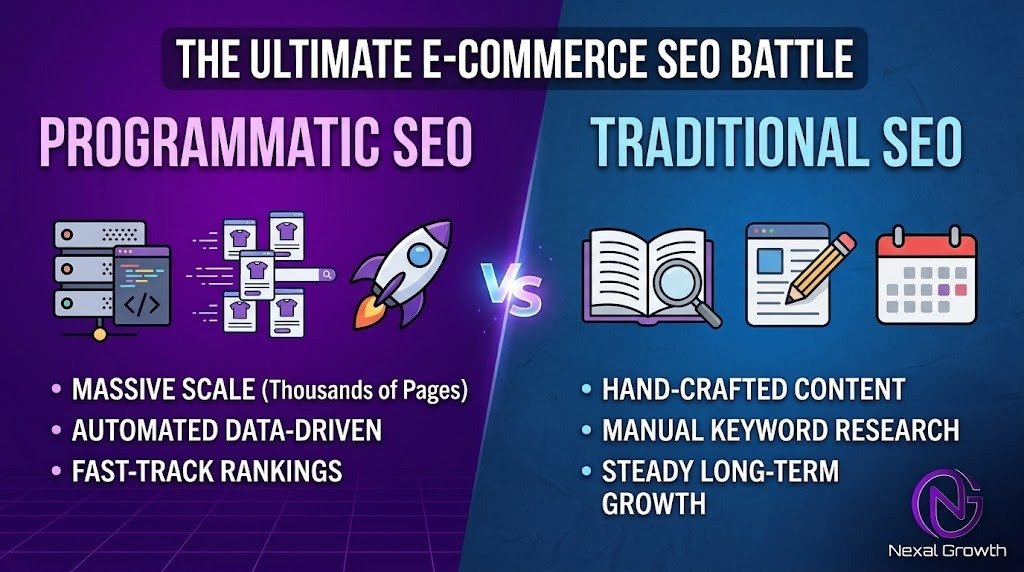
Managing an e-commerce catalog with thousands of SKUs creates a major technical bottleneck. You have to choose between writing unique descriptions for every single product variant or relying on auto-generated pages that search engines ignore. Traditional SEO solves the first problem by building authority for main categories, but it is too slow to scale. Programmatic SEO (pSEO) automates page creation for highly specific queries, allowing you to capture thousands of low-volume searches simultaneously.
Industry data from Ahrefs shows that roughly 92% of all search queries receive fewer than 10 searches per month. These are long-tail keywords. When a buyer searches for “Men’s waterproof North Face winter jacket size L,” they have their credit card in hand. Traditional manual writing simply cannot keep up with every possible size, color, and brand combination your store offers.
At NexalGrowth, we build hybrid e-commerce engines. We use traditional methods to secure competitive head terms and programmatic architecture to scale long-tail revenue. Both approaches are mandatory for capturing the entire market. Here is exactly how to deploy them without ruining your crawl budget.
Traditional SEO for E-Commerce: Dominating the “Head Terms”
Traditional SEO for e-commerce revolves around manual, highly researched content creation. This strategy targets broad search intent. It involves writing comprehensive buying guides, building backlinks, and carefully structuring your core category hubs.
You should deploy traditional SEO exclusively on pages with high search volume and fierce competition. Think of primary category pages like “Men’s Winter Jackets” or educational pillar pages such as “How to Choose a Winter Jacket for Extreme Cold.” These pages require human insight, nuanced copywriting, and a high degree of topical authority to rank against major retail giants.
The primary benefit of traditional SEO is that it builds foundational domain trust. A perfectly optimized, human-written guide signals to search algorithms that your site is a legitimate authority. This captures top-of-funnel browsers who are just beginning their research phase. However, manually building these pages takes weeks of effort per cluster. You cannot physically write 10,000 unique category guides for every attribute in your database.
Programmatic SEO (pSEO) for E-Commerce: Capturing High-Intent Long-Tail Sales
Programmatic SEO allows you to use your existing product database to automatically generate thousands of highly targeted landing pages. Instead of writing pages one by one, you build dynamic templates. These templates pull in real-time data from your Shopify, Magento, or Product Information Management (PIM) system.
The most effective place to use pSEO is within your faceted navigation. When a user filters your products by brand, size, and feature, the system generates a unique, optimized URL for that specific intersection. You instantly create pages for searches like “Red Nike running shoes for flat feet.” This eliminates the massive bottleneck of manual page creation for endless product variations.
This strategy captures bottom-of-the-funnel buyers. Searchers typing in hyper-specific attribute combinations already know exactly what they want to purchase. By scaling these long-tail keyword landing pages programmatically, you intercept buyers at the exact moment of decision. The upfront development time is high, but the marginal cost of creating the 5,000th page is effectively zero.
The E-Commerce Showdown: Which Strategy Does Your Store Need?
You do not have to choose one over the other. The most profitable e-commerce architectures layer both strategies together. To understand how to allocate your resources, review this structural breakdown.
| Feature | Traditional SEO | Programmatic SEO (pSEO) |
| Search Intent | Broad, research-heavy, top-of-funnel. | Hyper-specific, transactional, bottom-of-funnel. |
| Time to Launch | Months per topic cluster. | Days to weeks to launch thousands of pages. |
| Execution Constraint | Limited by human writers and editorial resources. | Limited by clean database architecture and engineering. |
| Cost Structure | High ongoing cost per page created. | High initial setup cost, near-zero cost per additional page. |
The Hidden Dangers of E-Commerce pSEO (And How We Prevent Them)
Scaling pages automatically carries significant technical risk if your underlying data architecture is flawed. Many store owners attempt to use automated plugins and accidentally destroy their organic visibility. Programmatic rollouts require strict technical governance to remain profitable.
Danger 1: Index Bloat & Crawl Budget Waste
Search engine bots only allocate a specific amount of time to crawl your website. If you generate 100,000 parameter URLs for every minor price filter or grid view, bots will waste their crawl budget on useless pages. This causes your actual revenue-generating products to fall out of the index. At NexalGrowth, we resolve this through strict canonicalization logic, precise robots.txt rules, and faceted URL control. We only allow search engines to crawl attribute intersections that possess actual search volume.
Danger 2: The “Thin Content” Penalty
Spinning manufacturer descriptions or launching blank template pages with just a few products will result in a thin content penalty. Search algorithms are highly aggressive against duplicate or low-value automated pages. The NexalGrowth fix relies on dynamic data enrichment. We design templates that dynamically pull in live inventory counts, aggregated user reviews, related product grids, and automated FAQs. This ensures every single programmatic page is 100% unique, semantically rich, and genuinely helpful to the searcher.
The NexalGrowth Hybrid Blueprint: Our E-Commerce SEO Methodology
Replacing manual labor with smart technical architecture is how you scale past your competitors. We execute this hybrid model through a strict, four-phase rollout designed specifically for digital growth.
Phase 1: Foundation (Traditional SEO)
We begin by securing your domain authority. We audit your site for technical health, resolve existing keyword cannibalization, and manually build authoritative core category hubs. This establishes the foundation of trust required for the next phases to succeed.
Phase 2: Database Structuring
Automation requires perfect data. We audit and clean your product database, ensuring all tags, meta-fields, and categories are uniform. Without clean database logic, programmatic templates will generate broken or nonsensical pages.
Phase 3: Programmatic Rollout
Our technical team designs high-converting, dynamic templates based on attribute intersections (e.g., Brand + Category + Feature). We deploy these templates across your faceted navigation, instantly creating thousands of optimized landing pages that target ready-to-buy searchers.
Phase 4: Smart Internal Linking
A programmatic page cannot rank if it sits isolated from the rest of your site. We build automated internal linking rules that route authority from your manually built traditional hubs down into the programmatic long-tail pages. This forces search engine bots to discover, crawl, and index your new automated inventory.
E-commerce growth requires both the high-quality human touch of traditional SEO and the massive scale of programmatic automation. Continuing to write manual descriptions for every single product variation limits your revenue potential and burns your resources. Do not trust your store’s complex architecture to basic content writers. Partner with technical e-commerce growth experts who understand how to manipulate crawl budgets and index logic. Book a free e-commerce SEO audit with NexalGrowth today, and we will analyze your catalog to show you exactly how many long-tail revenue opportunities your store is currently missing.



0 Comments
Leave a reply