

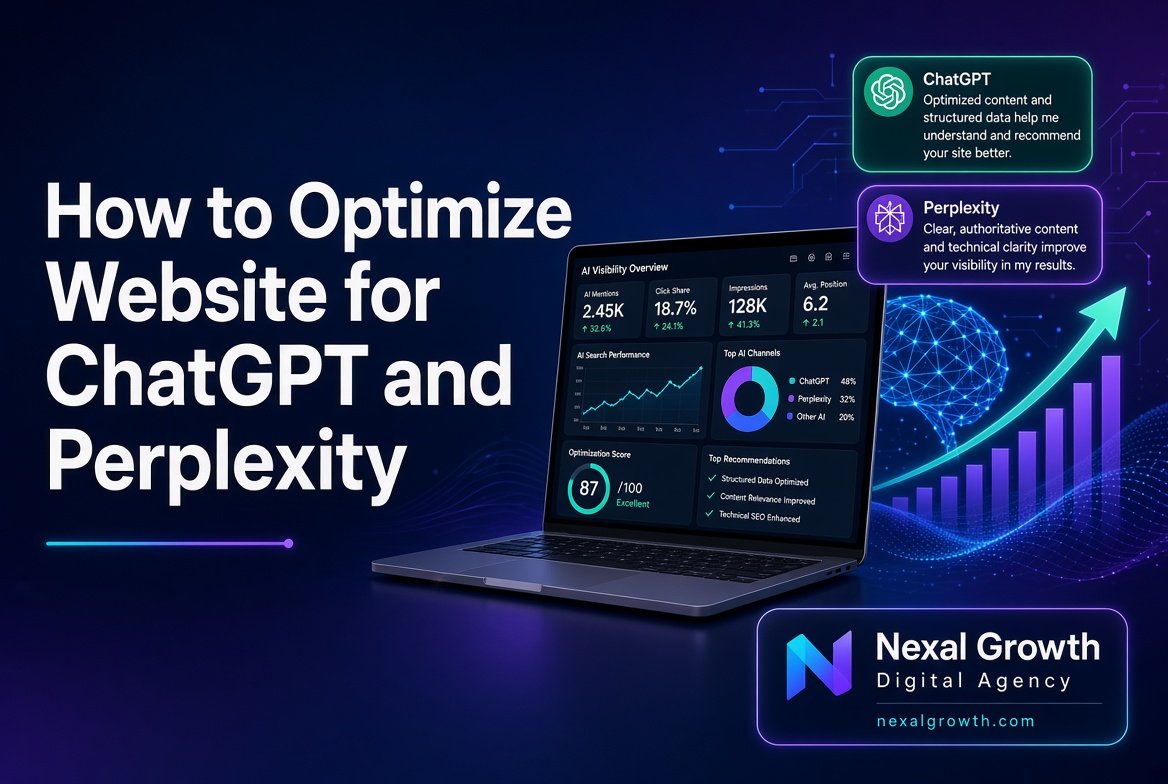
How to Optimize Website for ChatGPT and Perplexity: 2026 Guide
To optimize a website for ChatGPT and Perplexity, you must implement Generative Engine Optimization (GEO). This involves structuring content with direct factual answers, adopting Schema.org markup, securing citations across high-authority authoritative platforms, and establishing strong entity relationships to maximize inclusion in AI-generated answers.
The Shift from Traditional SEO to Generative Engine Optimization (GEO)
Traditional search engine optimization relies heavily on keyword density, backlinks, and matching user intent for traditional search engine result pages (SERPs). However, conversational AI platforms like ChatGPT, Perplexity, and Claude retrieve information differently. They act as answer engines, synthesizing real-time web content, Knowledge Graph data, and authoritative references to deliver direct responses to users.
To maintain market share and drive organic discovery in 2026, enterprise brands, SaaS founders, and B2B marketers must evolve from classic SEO to Generative Engine Optimization (GEO).
+-----------------------------------------------------------------------+
|                         THE EVOLUTION OF SEARCH                       |
+-----------------------------------------------------------------------+
| Traditional SEO (Google SERPs)   --->   Generative Engine Optimization|
| - Blue Links & Rank Position     --->   - Direct AI Answers           |
| - Keyword Matching               --->   - Entity & Semantic Context   |
| - Link Quantity                  --->   - Citation Frequency & Trust  |
+-----------------------------------------------------------------------+
4 Core Pillars to Rank in ChatGPT and Perplexity
1. Optimize for Entity Authority and Knowledge Graphs
AI models evaluate content based on Entities (people, places, concepts, organizations) and their relationships. To ensure LLMs recognize your brand as an industry leader:
- Implement robust Schema.org structured data (
Organization,TechArticle,Product, andFAQPage). - Maintain consistent NAP (Name, Address, Phone) and brand references across Wikipedia, Wikidata, Crunchbase, and top-tier industry directories.
- Structure clear subject-matter clusters that map out core industry terminology.
2. Format Content for Direct Extraction (Chunking)
Perplexity and ChatGPT search scrapers look for direct, highly contextual blocks of text to cite.
- Lead sections with concise 40-to-50-word summary definitions.
- Utilize logical heading hierarchies (H2, H3, H4) with clear semantic titles.
- Incorporate structured data formats like bullet points, ordered steps, and data tables that LLMs can digest effortlessly.
3. Build High-Authority Digital PR and Citations
Generative AI models prioritize sources with high trust and consensus across the web.
- Perplexity Search: Relies heavily on live index sources, indexing recent news, authoritative blogs, Reddit discussions, and technical documentation.
- ChatGPT (SearchGPT): Prioritizes web consensus, academic papers, and major industry publications.
- Gain secondary citations on trusted third-party review sites like G2, Capterra, and Trustpilot.
4. Provide Data-Backed, Original Insights
Generative models are trained to ignore generic fluff. They actively seek statistics, original benchmarks, technical framework breakdowns, and proprietary metrics (such as CAC, LTV, and ROAS performance benchmarks).
Legacy SEO vs. Nexal Growth GEO Strategy
| Strategy Dimension | Legacy Search Engine Optimization | Nexal Growth GEO Framework |
| Primary Goal | Direct organic clicks to web pages | Brand citations & inclusion in AI answers |
| Content Structure | Long-form articles optimized for keywords | Modular, entity-backed factual data blocks |
| Authority Metric | Domain Authority & Backlink Volume | Entity Sentiment & Brand Consensus Score |
| Technical Focus | Crawl budget, indexation, speed | Structured Schema, API integrations, LLM readability |
| Key Metrics | SERP Rankings & Organic Sessions | Share of Model (SoM), Conversions, Referral Traffic |
Technical Checklist to Optimize Website for ChatGPT and Perplexity
- [ ] Review
robots.txtPermissions: Ensure AI crawlers likeGPTBot,PerplexityBot,OAI-SearchBot, andChatGPT-Userare not blocked from indexing key resources. - [ ] Publish JSON-LD Structured Data: Add explicit entity links using
sameAstags pointing to recognized authority sites. - [ ] Maintain Real-Time Relevance: Perplexity weights recently updated data heavily; refresh key statistics regularly.
- [ ] Implement Clear Q&A Headers: Frame headings as natural language questions that target long-tail voice and chat queries.
- [ ] Optimize Digital Brand Mentions: Actively monitor unlinked brand mentions across technical forums and B2B platforms.
Frequently Asked Questions (PAA)
How long does it take to see results from Generative Engine Optimization?
While traditional SEO can take 3 to 6 months, GEO optimizations can yield visible citations in AI answers within 2 to 6 weeks. Real-time answer engines like Perplexity re-index high-authority content rapidly once structured markup and relevant digital PR citations are updated.
How do you measure ROI for AI search visibility?
ROI from AI search is measured by tracking Share of Model (SoM)—how frequently your brand is cited for industry prompts—alongside direct referral traffic from platforms like Perplexity and ChatGPT, brand query volume, and conversion rates from high-intent AI users.
Does GEO replace standard technical SEO?
No. GEO builds upon a strong technical SEO foundation. High site speed, clean crawl architecture, mobile optimization, and secure HTTPS connections remain prerequisite baseline signals for AI search bots crawling the web.
Scale Your Organic Growth with Nexal Growth
Don’t let your brand get left behind as search shifts from blue links to direct AI answers. At Nexal Growth, we help high-ticket B2B brands and enterprise SaaS companies dominate generative search platforms.
Ready to capture high-intent traffic from ChatGPT and Perplexity?
Book Your Free 30-Minute GEO & AI Search Audit with Nexal Growth Today



0 Comments
Leave a reply