

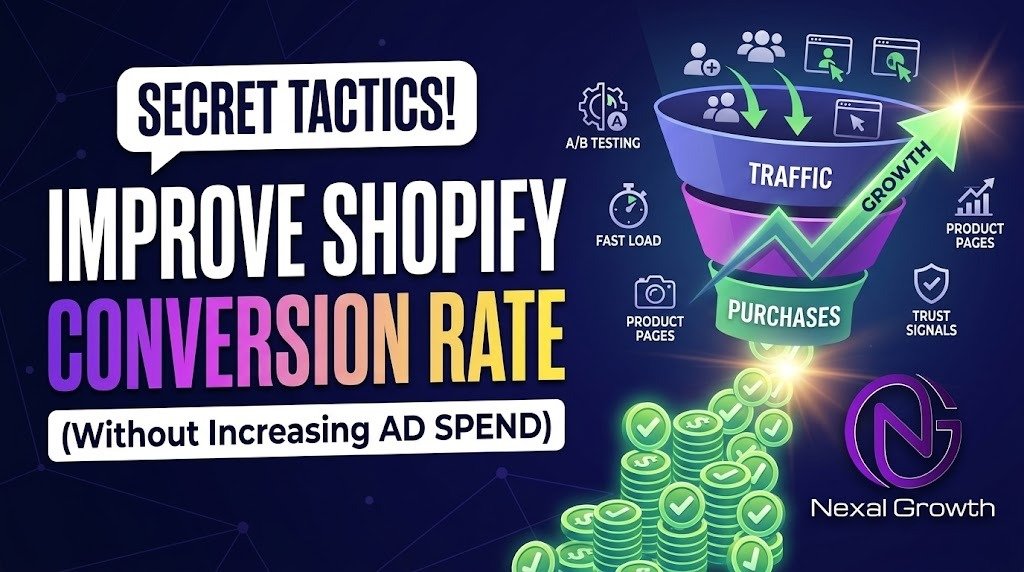
Improve Shopify conversion rate without increasing ad spend fast
Most Shopify store owners react to stagnant sales by instantly increasing their ad budget. This is a costly mistake that drains your profit margins. If your store currently converts at 1%, doubling your ad spend just doubles your customer acquisition cost without fixing the root problem.
To improve your Shopify conversion rate without spending more on ads, you must remove buying friction from your website. The core pillars of this strategy involve technical speed optimization, mobile-first design, persuasive product pages, and a frictionless checkout process. Fixing these exact elements allows you to extract significantly more revenue from the traffic you already generate.
At NexalGrowth.com, we constantly see brands lose thousands of dollars to slow load times, hidden fees, and weak social proof. We are going to break down exactly how to find and fix these conversion roadblocks right now.
Phase 1: Fixing the Invisible Technical Leaks
Now that the core strategy is clear, we need to address the structural issues causing silent bounces. Before tweaking your ad copy or changing images, you have to ensure your website actually functions the way modern buyers expect.
Problem 1: The 3-Second Drop-Off (Slow Page Speed)
Data shows that a mere one-second delay in mobile page load times can drop conversion rates by up to 7%. If your Shopify store takes longer than three seconds to load, you are literally paying for traffic that leaves before seeing your products.
The solution starts with auditing your store’s backend. Remove dormant or unused Shopify apps immediately, as they leave behind bloated JavaScript that slows down browser rendering.
You should also compress your media files using next-gen formats like WebP. Implement lazy loading so that images only load when the user actually scrolls down to them. At NexalGrowth, we run comprehensive Core Web Vitals audits to strip this heavy, redundant code without breaking your store’s essential functionality.
Once your site is loading instantly, you have to look closely at how people are navigating it.
Problem 2: The Mobile Friction Trap
Over 70% of modern e-commerce traffic comes from mobile devices, yet mobile conversion rates consistently lag far behind desktop rates. This happens because brands design their stores on large desktop monitors and completely ignore the thumb-scrolling experience of their actual buyers.
You can fix this by making all interactive buttons and calls-to-action (CTAs) at least 44×44 pixels. This specific size prevents frustrating misclicks for mobile users.
Add a sticky “Add-to-Cart” button to your product templates so the checkout option remains visible as users scroll through long descriptions. Furthermore, disable the auto-zoom feature on input fields for iOS devices to keep the mobile checkout flow smooth and uninterrupted.
Fixing this technical friction keeps visitors on your site, but the product page is where the actual buying decision happens.
Phase 2: Building High-Converting Product Pages
Many stores lose the sale right at the product description phase. Visitors view an item, read the text, but never click the buy button.
Problem 3: Feature-Dump Descriptions & Weak Visuals
This drop-off usually occurs because the copy reads like a dry technical manual rather than a solution to the buyer’s specific problem.
You need to shift your copywriting strictly from listing features to highlighting outcome-based benefits. Instead of stating a skincare serum has “hyaluronic acid,” tell the customer it “plumps skin and reduces morning wrinkles.”
Support this outcome-based copy with native-style demonstration videos and high-quality 3D visualizers. Show the product actually being used. Use Shopify’s “Compare at Price” feature strategically, applying it only during genuine promotions to maintain your brand’s integrity and pricing power.
Great copy explains the value clearly, but hesitant buyers still need validation from others before handing over their credit card details.
Problem 4: The “Trust Gap” (Lack of Social Proof)
A high add-to-cart rate paired with a low checkout initiation rate often indicates a massive trust gap. Shoppers like the product but aren’t entirely sure your brand will actually deliver on its promises.
Move beyond standard five-star text reviews, which modern consumers often view with heavy skepticism. Embed user-generated content (UGC), such as authentic customer photos and unboxing videos, directly near the Add-to-Cart button.
You can also add dynamic urgency indicators, like “Only 3 left in stock,” based on real-time inventory rather than deploying fake, spammy countdown timers. NexalGrowth implements seamless review collection systems like Loox or Judge.me to help you build this organic, visual trust on autopilot.
Even with high trust established, a clunky final step can ruin the entire acquisition process.
Phase 3: Plugging the Bottom-of-Funnel Leaks
The average e-commerce cart abandonment rate hovers dangerously around 70%. Much of this revenue loss happens because of surprise fees or a checkout process that feels unnecessarily complicated.
Problem 5: Checkout Friction & Surprise Fees
Never force your users to create a mandatory account to buy something; always enable guest checkout prominently.
Integrate one-tap payment options like Shop Pay, Apple Pay, and Google Pay to bypass tedious manual data entry. Most importantly, be fully transparent with your shipping costs on the product page itself, so users aren’t shocked by added fees at the final step. Address auto-fill is also a must-have to speed up typing on mobile keyboards.
Sometimes, despite a flawless checkout experience, life gets in the way and the buyer still leaves the site. You need an automated system to bring them back.
Problem 6: Ignoring the “Almost” Buyers (Abandoned Carts)
Ignoring shoppers who abandon their carts is exactly like leaving cash on the table. These are highly qualified leads who just need a slight, calculated nudge to complete their purchase.
Set up a highly targeted, three-part omnichannel recovery flow via email and SMS text messaging. Send a helpful, friendly reminder one hour after the cart abandonment.
At the 24-hour mark, send an email featuring social proof and UGC reviews of the specific item they left behind. Finally, at the 72-hour mark, introduce a scarcity trigger or a small, margin-safe discount code. Our team at NexalGrowth maps out and automates these personalized sequences to fit your exact buyer journey perfectly.
Setting these systems up is crucial for immediate wins, but true long-term optimization requires ongoing, systematic measurement.
Phase 4: Scaling Conversions with Data, Not Guesswork
Changing theme colors, landing page layouts, or headline copy based purely on personal preference is a highly risky way to run an e-commerce business. What looks visually appealing to you might actively confuse your customers and hurt your overall sales.
Problem 7: Relying on “Gut Feelings” for Store Changes
Instead of guessing, rely on continuous A/B testing to make strict, data-driven decisions.
Test one specific variable at a time, such as your hero image placement or your CTA button copy, to see what actually drives bottom-line revenue. Pair this quantitative testing data with qualitative tools like heatmaps and user session recordings. This allows you to see exactly where users are rage-clicking, getting confused, or dropping off entirely.
As a dedicated digital marketing and CRO agency, NexalGrowth runs these statistically significant tests consistently to ensure your conversion rate constantly improves month over month.
Stop Paying More for the Same Traffic
Increasing your daily ad spend on a poorly optimized Shopify store is like pouring expensive water into a bucket with holes in the bottom. You will get more volume, but you will lose just as much through silent leaks.
By optimizing your site speed, streamlining the mobile UI, building genuine social proof, and simplifying your checkout flows, you instantly increase your Return on Ad Spend (ROAS).
Ready to turn your existing traffic into actual, scalable revenue? Stop guessing and start converting today. Partner with NexalGrowth.com for a comprehensive Shopify CRO audit and let our team patch your funnel leaks for good.



0 Comments
Leave a reply