
Google Core Update Recovery Checklist for Agencies: 2026 ROI Plan
A Google core update recovery checklist for agencies is a systematic triage framework designed to diagnose sitewide algorithmic volatility, rectify content helpfulness deficits, audit information gain, and eliminate technical debt. Executing this structured workflow enables agencies to reverse organic traffic drops, protect client retainers, and restore pipeline ROI.
When Google rolls out a broad core update, digital agencies face a dual-front crisis: remediating sudden drops in algorithmic visibility and defending high-ticket client retainers against premature churn.
A core update does not target isolated technical glitches or penalize individual pages via manual actions; it recalibrates how Google’s machine learning systems evaluate overall site quality, authority, and user satisfaction across entire domains. For agencies managing multi-brand portfolios, a panicked, shotgun approach to remediation drains billable hours and dilutes client trust.
Recovering organic performance requires an analytical, enterprise-grade protocol. This checklist delivers an actionable operational playbook to diagnose root causes, reverse trajectory, and protect client customer lifetime value (LTV).
Strategic Shift: Reactive SEO vs. Algorithmic Resilience
Traditional recovery workflows rely on superficial fixes—tinkering with meta titles or artificially inflating word counts. Modern algorithmic recovery demands deep alignment with Google’s Quality Rater Guidelines, information gain scoring, and entity-based indexing.
| Diagnostic Vector | Reactive Agency Approach | Nexal Growth Enterprise Framework |
| Triage Protocol | Immediate page edits during active rollout | Rollout stabilization window + 14-day volatility modeling |
| Content Remediation | Adding generic word count and AI filler | Information gain auditing, first-hand data, entity enrichment |
| Technical Focus | Surface-level crawl error fixing | Crawl budget routing, intent clustering, rendering efficiency |
| Brand Authority | Indiscriminate backlink acquisition | Entity footprint mapping, co-citation building, author schema |
| Client Governance | Defensive, ad-hoc status calls | Proactive impact containment, CAC/pipeline attribution modeling |
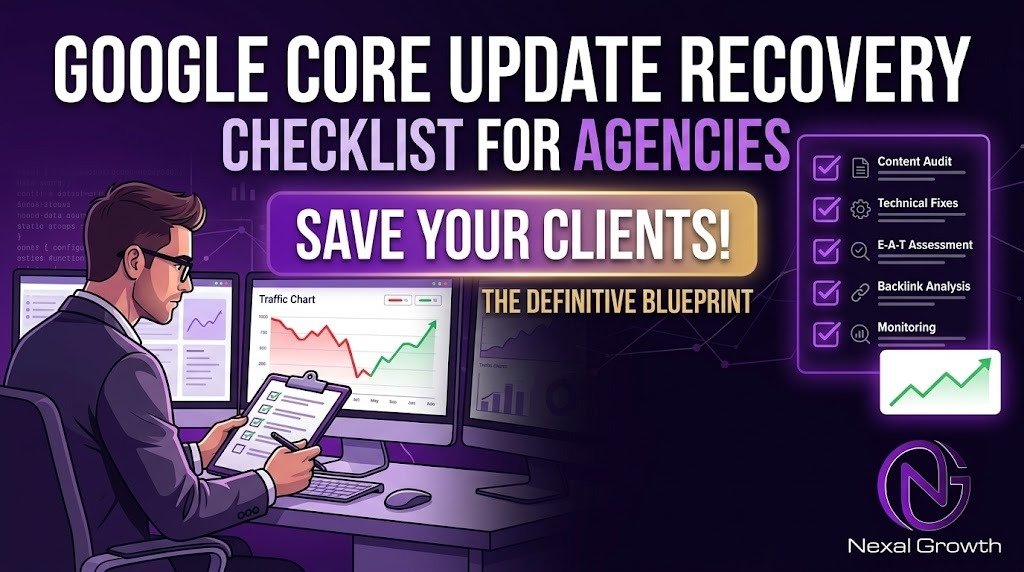
The 5-Phase Google Core Update Recovery Checklist
Phase 1: Rollout Isolation and Impact Modeling
Avoid making structural site changes while the update is actively deploying. Early SERP turbulence often reflects algorithmic testing and temporary re-ranking.
- [ ] Track Rollout Windows: Document the exact start, peak volatility dates, and official completion announced by Google Search Central.
- [ ] Segment Traffic by Intent and Template: Isolate informational blog traffic from transactional/commercial bottom-of-funnel URLs in Google Analytics 4 (GA4).
- [ ] Dissect Query-Level Impressions in GSC: Filter Google Search Console data by query intent to distinguish pure rank loss from intent reclassification.
- [ ] Assess Competitive SERP Composition: Analyze winning competitors to identify whether Google shifted preference toward user-generated content (Reddit/forums), direct answers, or specialized vertical authorities.
Phase 2: Information Gain and Content Utility Audit
Recent core updates aggressively suppress unoriginal, synthesized content that provides zero net value beyond existing search results.
- [ ] Audit for Information Gain: Identify whether your client’s content introduces proprietary data, unique case studies, expert commentary, or original research.
- [ ] Prune or Consolidate Low-Value URLs: Identify pages with near-zero conversions and declining impressions over 180 days. Implement 301 redirects to comprehensive parent guides or apply
noindextags. - [ ] Eliminate “Made-for-SEO” Fluff: Remove redundant introductory headers, generic historical overviews, and filler text that delays search intent resolution.
- [ ] Verify Conversion Paths: Ensure that commercial pages provide frictionless UX with clear value propositions, transparent pricing tiers, and accessible primary conversion points.
Phase 3: Technical Architecture and Search Engine Rendering
Algorithmic evaluations heavily weight user satisfaction signals, mobile rendering integrity, and clean indexing architecture.
- [ ] Audit Internal PageRank Distribution: Ensure high-converting commercial hubs receive adequate internal link equity from topically relevant sub-pages.
- [ ] Resolve Canonical and Duplication Conflicts: Consolidate syndicated content, self-competing keyword variants, and programmatic faceted navigation leaks.
- [ ] Inspect Core Web Vitals (CWV) Field Data: Audit Interaction to Next Paint (INP), Largest Contentful Paint (LCP), and Cumulative Layout Shift (CLS) using real-world CrUX data rather than simulated lab runs.
- [ ] Validate Structured Data Consistency: Implement clean, fully resolved
Organization,Article,Service, andAuthorschema markup to solidify knowledge graph associations.
Phase 4: E-E-A-T and Entity Authority Hardening
Google evaluates trust as the central pillar of its Quality Rater framework. Demonstrating genuine operational expertise is essential for high-stakes B2B and YMYL (Your Money or Your Life) niches.
- [ ] Establish Verifiable Author Bylines: Tie every high-impact publication to a verifiable subject-matter expert with public credentials, LinkedIn validation, and external citations.
- [ ] Harden Domain-Level Trust Signals: Update the client’s “About Us,” editorial policy, physical location signals, contact accessibility, and enterprise privacy standards.
- [ ] Review External Brand Sentiment: Audit reviews on G2, Capterra, Trustpilot, and Google Business Profile to identify brand reputation headwinds that algorithmic systems flag.
- [ ] Build High-Value Digital PR Mentions: Realign off-page acquisition toward contextual editorial coverage, podcast features, and industry whitepaper references.
Phase 5: Client Retention and Revenue Protection Protocol
For an agency, managing client psychology during rank drops is as vital as the technical recovery itself.
- [ ] Deploy a 24-Hour Executive Memo: Immediately notify affected clients that volatility has been detected, define the algorithmic context, and set expectations for the stabilization window.
- [ ] Pivot to High-ROAS Performance Channels: Temporarily reallocate internal focus toward conversion rate optimization (CRO) and paid search capture to safeguard pipeline volume while organic stabilizes.
- [ ] Establish Clear Recovery Milestones: Report progress on indexation health, impression stabilization, and content optimization velocity instead of vanity rank swings.
People Also Ask (PAA)
How long does it take an agency client to recover from a Google core update?
Substantial recovery typically requires 3 to 6 months, often culminating during the subsequent broad core update or minor algorithmic refresh. While technical rectifications and content pruning can yield incremental impression gains within 30 to 45 days, full authority recalibration occurs once Google’s systems recrawl and re-evaluate the entire domain over sustained evaluation cycles.
How do we differentiate between an algorithmic drop and a manual action?
A manual action is accompanied by a formal notification inside Google Search Console under “Security & Manual Actions,” typically tied to explicit violations like unnatural backlink schemes or structured data manipulation. Algorithmic core updates carry no console notifications; they manifest as sudden, sitewide drops in visibility and impressions coinciding directly with public Google rollout dates.
How should agencies measure ROI during a post-update recovery campaign?
Agencies should measure recovery ROI through blended customer acquisition cost (CAC), pipeline velocity, and organic revenue recapture rather than keyword positions alone. Focus on conversion value per organic visitor and calculate the cost savings of organic pipeline restoration against equivalent paid media spend (PPC replacement value).
Turn Algorithmic Volatility into a Competitive Moat
Algorithmic shifts separate modern, performance-first agencies from commoditized SEO vendors. When your clients experience search volatility, they do not need reassurance—they need an empirical, revenue-focused recovery roadmap.
At Nexal Growth, we partner with enterprise agencies, high-growth B2B SaaS companies, and digital brands to diagnose algorithmic penalties, restructure digital assets, and engineer resilient acquisition funnels that scale regardless of search engine volatility.
Ready to reverse organic losses and future-proof your client portfolio?
Book an Enterprise Algorithmic Audit at Nexal Growth to consult with our search strategists and unlock a custom roadmap for sustainable pipeline expansion.



0 Comments
Leave a reply