

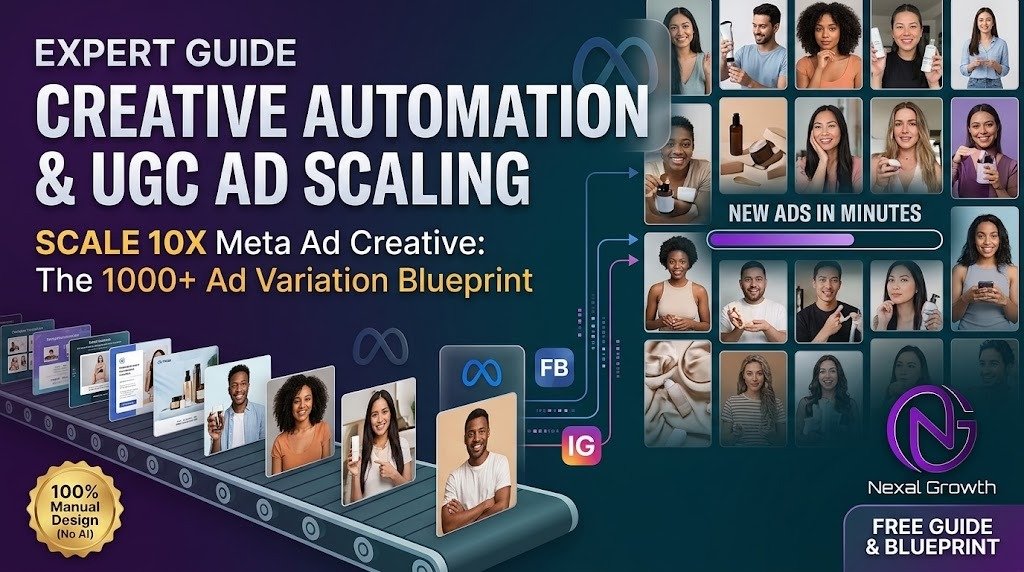
Creative automation and ugc ad scaling for meta | Expert Guide
If your direct-to-consumer brand spends over $50,000 a month on Meta, you are likely hitting a severe creative bottleneck. Meta’s Advantage+ Shopping Campaigns (ASC) are highly efficient, but they aggressively burn through fresh ad creatives in just 7 to 14 days.
To maintain a profitable Return on Ad Spend (ROAS), you cannot simply hire more creators. Instead, you must combine raw user-generated content (UGC) with a creative automation pipeline.
The core metric of success on Meta right now is creative velocity. A single winning UGC video must be systematically broken down into dozens of dynamic variations. By testing different hooks, middle bodies, and end cards, you feed the algorithm exactly what it needs without inflating your production budget.
At NexalGrowth, we build these exact modular video systems for our clients. We solve ad fatigue by turning one raw creator asset into 30 unique, test-ready Meta ads.
Here is exactly how this framework operates, why traditional methods fail, and how you can implement this system to scale your campaigns.
1. The Creative Bottleneck: Why Traditional UGC Fails at Scale
The standard approach to UGC production is highly inefficient for modern media buying. Most brands hire five creators a month, manually edit ten videos, and launch them into an ad account.
This manual process breaks down quickly at scale. When you increase your daily budget, Meta’s machine learning algorithm cycles through those ten videos in a matter of days. Once the target audience sees the same visual hook multiple times, your Click-Through Rate (CTR) drops.
When CTR drops, your Cost Per Click (CPC) rises. This immediately increases your Cost Per Acquisition (CPA), killing your campaign profitability.
Simply hiring 30 creators instead of five does not fix this. It creates a massive logistical nightmare of briefing, managing, and editing. The problem is not a lack of creators; the problem is a lack of an automated asset pipeline.
Understanding this bottleneck changes how you approach creative strategy. The next step is shifting from manual editing to automated variation.
2. What is Creative Automation in UGC? (The NexalGrowth Engine)
Creative automation for UGC separates the raw footage from the final advertising package. You stop thinking of a UGC ad as a single, static video.
Instead, you treat the creator’s raw footage as modular building blocks. The “packaging” consists of dynamic text overlays, changing aspect ratios, AI-generated captions, and distinct first-three-second hooks.
We use a specific mathematical approach to asset generation. One 60-second raw UGC video is sliced into modular components:
- 5 Distinct Hooks: The critical first three seconds of the video.
- 2 Middle Bodies: The core value proposition and product demonstration.
- 3 Call-to-Actions (CTAs): The final offer and end card.
Through batch rendering and automated editing workflows, these components are mixed and matched. 5 hooks multiplied by 2 bodies and 3 CTAs equals 30 unique video variants.
You only paid one creator, but you now have a month’s worth of fresh creative ammunition for your Meta ad sets.
Now that the math makes sense, you need to understand the practical execution in your daily operations.
3. Step-by-Step: Building Your Meta Creative Automation Pipeline
Setting up this engine requires a strict, repeatable process. At NexalGrowth, we structure this into three distinct phases to ensure consistent output.
Phase 1: High-Conversion UGC Briefing You must brief creators for modularity. Do not ask for a single, seamless script. Instead, ask them to film five different opening sentences separately. We use the Problem-Agitate-Solve (PAS) framework. The creator films the “Problem” (the hook) multiple times in different settings. They then film the “Solve” (the product usage) separately. This ensures the raw footage is easy to slice later.
Phase 2: Automated Variant Generation Once the raw files are delivered, they enter the automation workflow. We use batch-processing software to apply dynamic caption burn-ins and format the videos. Every variation is automatically exported into 9:16 for Instagram Reels, 1:1 for the Facebook Feed, and 4:5 for general placements. This removes hours of manual timeline adjustments.
Phase 3: Meta Account Structure Integration You must test these variants without resetting Meta’s learning phase. We upload the modular variants into Dynamic Creative Optimization (DCO) ad sets. Meta automatically tests the 30 variations against each other at a low budget. Once the algorithm identifies the winning combination of hook and text, we extract that specific post ID. We then move that proven winner into our primary Advantage+ scaling campaign.
Building the pipeline gives you the assets. However, analyzing the resulting data is what actually lowers your CPA.
4. The Data Loop: How to Diagnose UGC Performance on Meta
You cannot scale ads on emotion; you must scale them based on specific in-platform metrics. Our automated pipeline allows us to isolate variables and read the data accurately.
Hook Rate (3-Second Video Plays / Impressions): This metric tells you if the first three seconds are stopping the scroll. We look for a benchmark Hook Rate of 35% or higher. If a variant has a 15% hook rate, we immediately swap the opening clip using our modular library.
Hold Rate (ThruPlays / 3-Second Video Plays): This measures the middle body of the UGC. If your hook rate is 40% but your hold rate is under 5%, people are interested but get bored quickly. This data tells us to speed up the pacing or add more b-roll to the middle section.
Outbound CTR and CVR: A high hook rate means nothing if users do not click and buy. We monitor outbound CTR to ensure the creative actually drives purchase intent, not just cheap views.
Applying this strict data diagnosis yields predictable revenue growth, as demonstrated in our active client accounts.
5. Case Study: Scaling D2C Revenue on Meta
To illustrate this, consider a recent D2C client who came to us stuck at $40,000 a month in ad spend. They were experiencing severe creative fatigue. Their CPA would spike every 10 days, forcing them to turn off campaigns.
We immediately stopped their manual video editing process. We sourced three creators and applied the NexalGrowth modular framework.
From those three creators, we generated 90 automated variants. We fed these into a strict DCO testing structure. We isolated the top three winning hooks and scaled them aggressively in an Advantage+ campaign.
The results were immediate. We scaled their ad spend to $200,000 per month while maintaining a 4.2x ROAS. Furthermore, we reduced their creative production turnaround time by 80%.
6. Stop Fighting Ad Fatigue Alone — Partner with NexalGrowth
Manual UGC production is the primary bottleneck preventing growth-stage brands from reaching 7-figure monthly run rates. The Meta algorithm demands volume, and traditional editing cannot keep up.
By implementing creative automation, you regain control over your CPA, reduce creator costs, and maintain a constant flow of fresh, data-backed ads.
If your current agency or internal team is struggling with ad fatigue, it is time to upgrade your system. Partner with NexalGrowth.com today. Let us build, manage, and scale your automated Meta creative engine so you can focus on running your business.



0 Comments
Leave a reply