

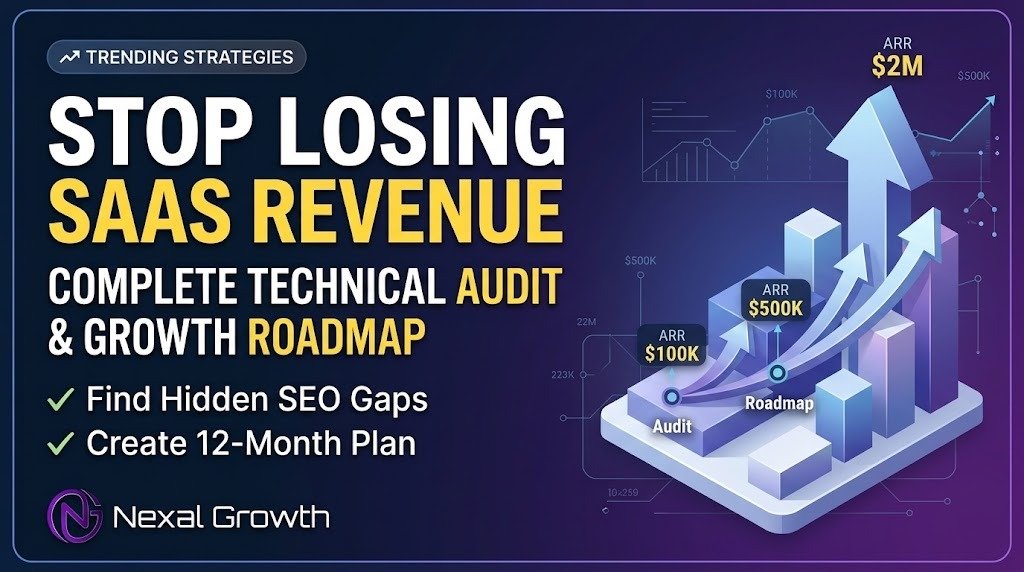
Technical SaaS SEO Audit and Growth Roadmap: Turn Vanity Traffic into MRR
Introduction: The SaaS Organic Growth Trap
Most SaaS companies get stuck ranking for Top-of-Funnel (TOFU) informational queries that look great on analytics dashboards but generate zero pipeline. The core issue is that high-converting Bottom-of-Funnel (BOFU) pages—like pricing, feature comparisons, and integration lists—are often buried due to technical roadblocks. You do not need more traffic; you need qualified leads that convert into Monthly Recurring Revenue (MRR).
A technical SaaS SEO audit operates as a revenue-first diagnostic. It identifies exactly why commercial pages fail to index, focusing on JavaScript rendering failures, crawl budget waste, and app subdomain bleed. The goal is to unblock commercial rankings and build a roadmap that directly ties organic growth to pipeline generation.
At Nexal Growth, we skip the vanity metrics and focus on turning visibility into actual trial signups and qualified leads. We deploy a systematic approach to search engine optimization tailored specifically for B2B software companies.
The technical foundation of a SaaS website dictates its organic success. Search engines must be able to crawl, render, and index your content before you can compete for high-intent keywords. When your site relies heavily on modern frameworks without proper server-side rendering, search bots receive empty HTML. This renders your most important pages invisible to both Google and AI search agents.
Phase 1: The Technical SaaS SEO Audit (Identifying the Revenue Blockers)
A standard site audit checks for broken links and missing meta descriptions. A SaaS-specific audit diagnoses the structural mechanics preventing customer acquisition.
1. Crawlability, JavaScript Rendering, and App Subdomains
Many SaaS sites are built on JavaScript frameworks like React, Next.js, or Angular. Search engines struggle to render client-side JavaScript at scale, often leaving crucial feature and pricing pages entirely deindexed. Furthermore, app subdomains (like app.yourdomain.com) frequently bleed into search results, causing indexation bloat and wasting crawl budget on empty application states.
We fix this by auditing Server-Side Rendering (SSR) capabilities. They ensure the server delivers fully rendered HTML to search crawlers immediately. We also strictly control robots.txt directives for the app side to keep logged-in user states out of the search index entirely.
2. Resolving Keyword Cannibalization on “Money” Pages
Keyword cannibalization occurs when your blog posts outrank your actual product landing pages for high-intent keywords. This splits your domain’s authority and sends ready-to-buy users to educational articles instead of conversion pages.
We resolve this by mapping keyword intent to specific URLs. We consolidate competing pages through strategic 301 redirects and tighten the internal linking structure around two or three core revenue clusters. This funnels authority directly to your highest-converting assets.
3. AI Engine Optimization (AEO) & Semantic Readiness
AI search engines like ChatGPT, Perplexity, and Google’s AI Overviews are intercepting a massive share of SaaS queries. Pew Research indicates users click a result in only 8% of searches showing an AI summary, compared to 15% without one. If your technical SEO ignores entity mapping, you lose visibility in these new channels.
We implement SaaS-specific structured data to make your site machine-readable. Using SoftwareApplication, FAQ, and Review schema translates your content into entities for Large Language Models (LLMs). This ensures AI bots can extract and cite your product features accurately.
4. Core Web Vitals and the Trial Signup Flow
Slow page loads and layout shifts specifically on demo-request or trial-signup pages cause immediate friction. Industry data shows a 4.42% conversion drop for every single extra second a site takes to load. This technical bloat kills conversion rates before the lead is even captured in your CRM.
We diagnose script delays and optimize the Largest Contentful Paint (LCP) across your entire conversion funnel. By removing unnecessary third-party scripts from the signup flow, we ensure the user experience remains fast and stable. This directly protects and improves your conversion rates from organic traffic.
Phase 2: The SaaS SEO Growth Roadmap (Execution & Scaling)
An audit identifies the problems, but a roadmap dictates how to sequence the fixes for maximum revenue impact.
Month 1: Foundation & Technical Debt Cleanup
The first thirty days are dedicated to deploying critical architectural fixes alongside your engineering team. We resolve redirect chains, fix JavaScript rendering failures, and roll out comprehensive schema markup across the site. We also prune low-value URLs that waste your crawl budget.
Immediate focus goes to pushing BOFU keywords—such as “vs competitors,” “alternatives to,” and “pricing”—to page one. We achieve this by optimizing the internal link architecture to flow authority directly to these money pages, capturing demand that already exists.
Months 2-3: Hub-and-Spoke Deployment & Content Consolidation
New content takes time to rank, so we start by refreshing decaying content that already has authority. Updating existing posts is proven to drive traffic faster than publishing new articles from scratch.
We then build a Hub-and-Spoke cluster model. This structure organizes your content around core topics, channeling topical authority directly from educational blog posts to your core product landing pages.
Months 4-6: Pipeline Attribution & Compounding Authority
We shift the reporting KPIs from arbitrary clicks to Marketing Qualified Leads (MQLs) and Sales Qualified Leads (SQLs). We track organic pipeline velocity and calculate the exact Customer Acquisition Cost (CAC) from organic search. A healthy SaaS Lifetime Value to CAC (LTV:CAC) ratio sits around 3:1, and segmenting this by channel proves the financial value of organic traffic.
During this phase, we execute digital PR and link acquisition specifically for the feature and integration pages that drive revenue. Building authority directly to the bottom of the funnel accelerates trial signups and builds a defensible moat against competitors.
Month 6+: Programmatic SEO for SaaS
Once the foundation is solid, we scale growth using programmatic SEO. We programmatically generate high-converting pages for specific software integrations and granular use cases.
Targeting queries like “SaaS tool + Slack integration” captures highly specific, conversion-ready search intent at scale. This expands your total addressable market without requiring manual content creation for hundreds of individual keyword variations.
How Nexal Growth Transforms Your Organic Pipeline
Most agencies treat SaaS like any other website, optimizing for traffic volume rather than the B2B SaaS buyer journey. This results in high top-of-funnel traffic but entirely flat revenue.
We are a performance-driven digital marketing agency that understands your SaaS growth is a system, not luck. We run deep technical diagnostics paired with a commercial growth roadmap to turn your website into a defensible lead source.
Stop losing high-intent customers to competitors with better technical foundations. Contact Nexal Growth today to claim your custom Technical SaaS SEO Audit and let us build a roadmap that scales your MRR.



0 Comments
Leave a reply