Choosing the wrong platform for your specific business model will cost you thousands in development and lost opportunity. Scaling an e-commerce brand requires a robust foundation that handles 10,000+ SKUs, complex architecture, and high traffic without breaking.
The reality is that 43% of all e-commerce traffic comes from organic search. It is the most profitable acquisition channel for retail brands. Yet, founders waste months debating basic meta tags instead of solving enterprise-level challenges like technical bloat and execution bottlenecks.
Let’s address the core issue right now. The platform itself is rarely your bottleneck; your execution is. Shopify provides out-of-the-box scale with zero server maintenance. WordPress provides total architectural control at the cost of high technical debt.
This breakdown reveals the actual technical and financial differences between these platforms so you can make a profitable, data-backed decision.
The $50,000 Question: Does Your Platform Actually Matter for SEO?
Brands frequently spend $5,000 to $50,000 migrating platforms just to fix flatlining organic traffic. They expect a new content management system to act as a magic ranking bullet.
In reality, over 60% of SEO ranking factors are completely platform-agnostic. Backlink profiles, content depth, user experience, and search intent matter far more than your codebase. Both Shopify and WordPress can hit the #1 spot for hyper-competitive terms today. Search engines index clean HTML, regardless of which database generated it.
Frame the debate differently. It is not about “Good SEO versus Bad SEO.” The true battle is Simplicity versus Total Control. When you scale past a $1M run rate, managing resources becomes critical. Organic search generates an 8x return compared to PPC, meaning your technical foundation must support rapid growth without requiring constant fixes.
The Technical SEO Showdown (Managing 10,000+ SKUs)
Shopify’s Technical Engine: Out-of-the-Box Scale
The Good:
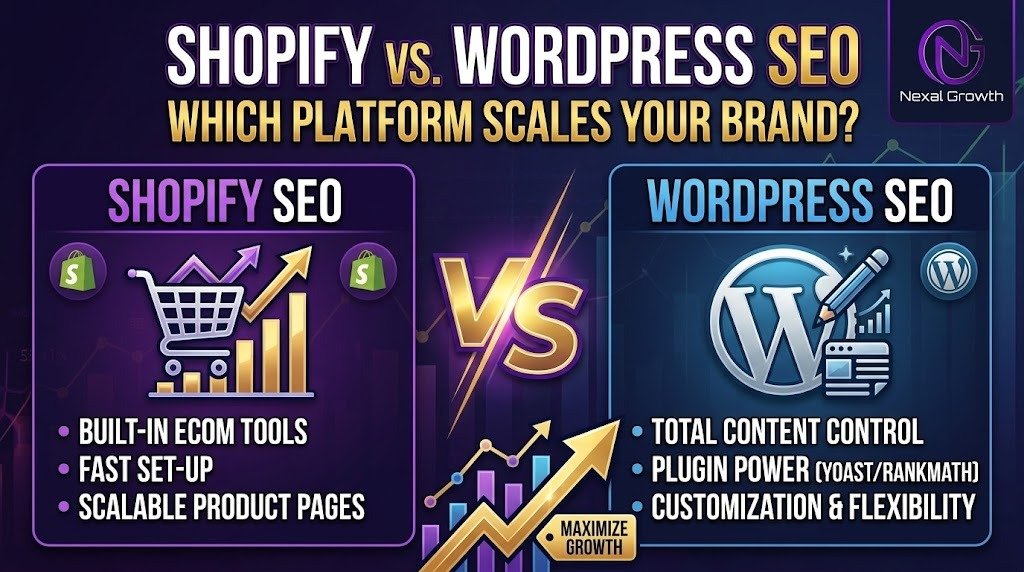
Shopify is built to handle massive traffic spikes natively. You get auto-generated canonicalization, built-in CDN speed, and flawless SSL without lifting a finger. Your team spends zero hours on server maintenance or caching configurations. For a brand expanding its catalog rapidly, this reliability is highly valuable. Your site simply stays online and loads quickly during peak sales events.
The Bad (The “Shopify is Bad for SEO” Myth):
Many SEO purists complain about Shopify’s forced URL structures. The platform automatically injects /products/ and /collections/ into every slug. While this limits complete customization, it is rarely a true ranking barrier for scaling brands. Search engines easily understand this logical folder structure. It is a minor annoyance for developers, but it is not a critical failure for your revenue.
WordPress/WooCommerce: Unrestricted Architectural Control
The Good:
WordPress shines when you need absolute control over your environment. You get deep server log file access and unrestricted custom schema markup capabilities. You can build dynamic internal linking rules and create custom URL nesting. This level of customization is crucial for complex, multi-category catalogs where faceted navigation requires exact parameter handling to avoid duplicate content issues.
The Bad (The Plugin Trap):
Scaling WordPress requires a precarious stack of third-party tools. You need caching plugins, SEO plugins like Yoast or RankMath, and deep database optimization. These tools often conflict with each other. They break during core updates and can severely drag down your Core Web Vitals if they are not actively managed by a dedicated developer.
Content-Led vs. Product-Led SEO: Choosing Your Weapon
When WordPress Wins (The Content-Led Brand)
Some businesses sell complex, high-ticket, or heavily researched products like B2B equipment or specialized supplements. WordPress dominates here. Its taxonomy and custom post types allow brands to build massive resource hubs, glossaries, and education centers. These editorial assets seamlessly interlink with product pages to capture top-of-funnel traffic. Shopify’s basic blogging function simply cannot handle this advanced level of content architecture.
When Shopify Wins (The Product-Led Brand)
Direct-to-consumer (D2C) brands driving volume through catalog size and visual commerce need a different approach. If you sell apparel or fast-moving consumer goods, you do not need complex editorial structures. You need fast-loading product pages, flawless mobile checkout, and easy category management. Data shows that Shopify stores launch 41% faster on average than comparable WooCommerce stores. This speed allows product-led teams to focus strictly on merchandising and conversion.
The Hidden “Total Cost of SEO Ownership” (TCO)
The financial cost of managing SEO on these platforms is rarely discussed upfront. A successful organic strategy requires continuous investment beyond the initial software subscription.
The WordPress Tax:
The core WordPress software is free, which saves you monthly SaaS fees. However, you pay a heavy premium in developer retainers. You must constantly pay professionals to keep the site secure, fast, and technically sound as traffic scales. Server upgrades, database optimization, and vulnerability patching will eat into your marketing budget quickly.
The Shopify Tax:
Shopify requires a higher baseline subscription, especially if you move to Shopify Plus. You will also rely on paid third-party apps for advanced SEO features like custom schema or advanced product reviews. The trade-off is that you waste absolutely zero hours on server maintenance.
| Cost Category | WordPress/WooCommerce | Shopify |
| Hosting & Servers | Scales up heavily with traffic spikes | Included in fixed monthly fee |
| Developer Costs | High (constant maintenance needed) | Low (platform manages backend) |
| App/Plugin Fees | Moderate (mostly one-time or low annual) | High (monthly recurring fees) |
| Technical Debt | High risk of plugin conflicts | Low risk due to closed ecosystem |
The NexalGrowth Migration Matrix: Stay or Switch?
Making the wrong move will stall your organic growth for months. Use this direct framework to decide your next step.
Stay on Shopify if:
Your primary organic traffic bottleneck is content quality and backlinks, not technical architecture. If your site is fast and search engines index your pages smoothly, a platform migration will not fix your underlying ranking problems.
Migrate to WordPress if:
Content marketing and editorial SEO drive the vast majority of your top-of-funnel acquisition. If Shopify’s rigid taxonomy is actively preventing you from siloing educational content, WordPress will unlock that architectural growth.
Migrate to Shopify if:
Your scaling WordPress site keeps crashing during major sales events. If your developer bills are eating your marketing budget and you want to focus strictly on selling products, Shopify is the clear answer for stability.
Scaling E-Commerce SEO Requires Execution, Not Just Software
An optimized Shopify store will always outrank a poorly managed WordPress store, and vice versa. The software does not do the work; your execution team does. Platform architecture only sets the baseline for your growth.
Scaling brands do not necessarily need a risky, expensive website migration. They need a high-ROI organic growth engine that executes flawlessly. At nexalgrowth.com, we specialize in extracting maximum SEO value out of both Shopify and WordPress. We handle the advanced technical audits, authoritative link-building, and conversion-focused content required to scale revenue.
Stop blaming your platform for flatlining traffic. Focus on building an architecture and content strategy that actually converts. Visit nexalgrowth.com to implement a technical SEO strategy that directly impacts your bottom line.