

10 Million Token Context AI Models: 2026 Enterprise Guide
Processing massive datasets without fragmentation is the primary technical hurdle for enterprise AI in models with 10 million token context window 2026. Models with a 10 million token context window have shifted the baseline, eliminating the need for complex Retrieval-Augmented Generation (RAG) pipelines in many enterprise use cases. You no longer have to chunk documents, optimize vector databases, or risk losing critical logic chains across multiple overlapping prompts.
Instead, you can load entire codebases, decades of financial history, or massive legal archives directly into a single query. This immense capacity equals roughly 7.5 million words or 15,000 pages of text processed simultaneously. Market leaders like Meta’s Llama 4 Scout and Google’s Gemini 3.1 Pro are setting the standard for this new tier of data ingestion.
The true value of these models lies in their ability to maintain high fidelity across these immense inputs. Earlier iterations of large language models suffered from severe data degradation. when pushed to their limits, but 2026 architectures utilize advanced attention mechanisms to retain granular accuracy. This means your autonomous agents and data analysis workflows can now operate with near-perfect recall across millions of tokens.
Understanding the mechanics behind these technological advancements requires looking at how context limits are actually utilized in real-world scenarios. Let’s break down exactly what a 10 million token capacity means in practical terms and how it solves legacy AI bottlenecks.
What Does 10 Million Tokens Actually Mean?
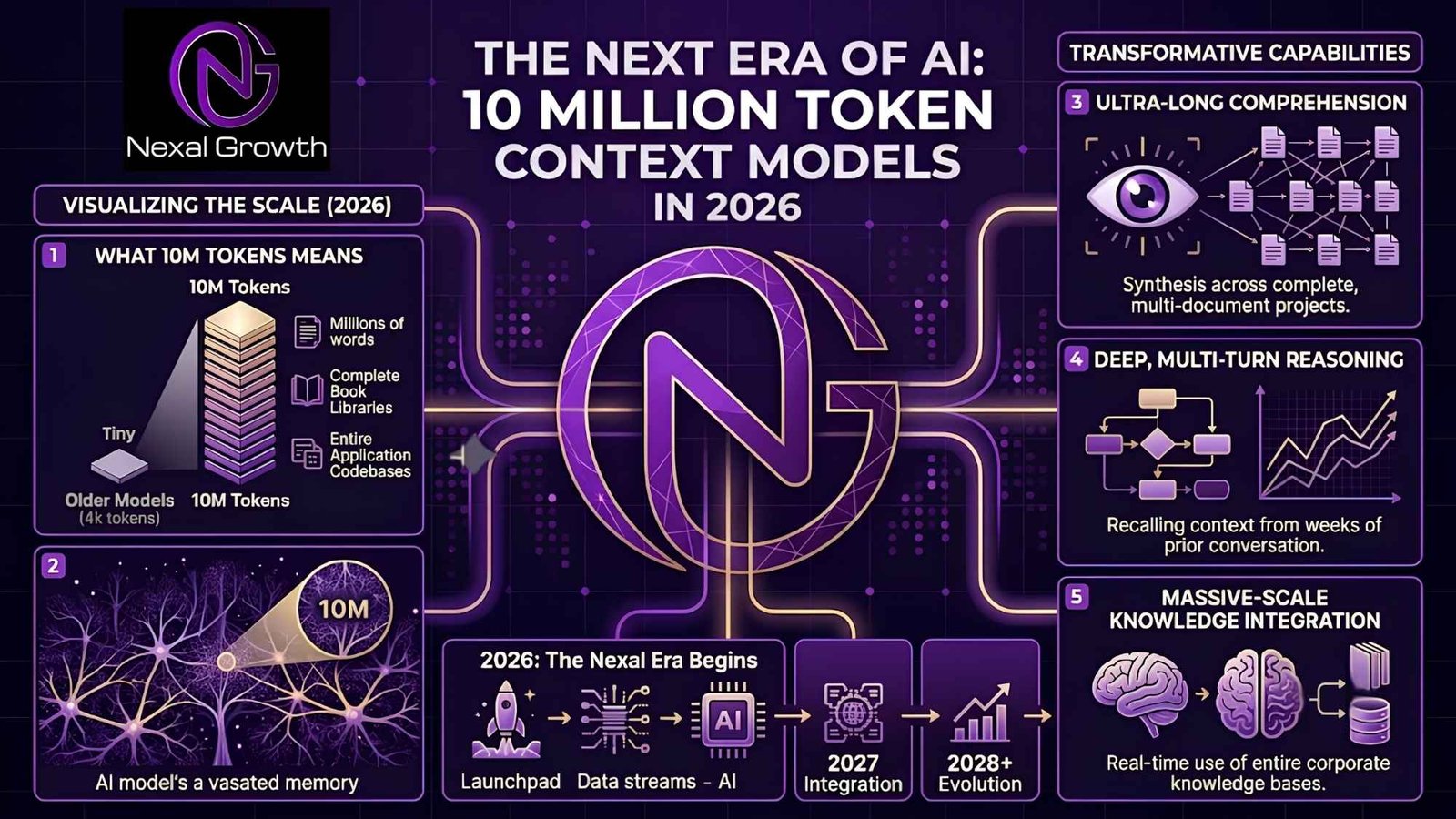
Visualizing this immense scale helps clarify why this is a massive operational shift for businesses. A single token generally represents about four characters or roughly three-quarters of a standard English word. When a model successfully processes 10 million tokens, it is analyzing the equivalent of 7.5 million words in one cohesive thought process.
To put that mathematical scale into perspective, a standard novel contains about 100,000 words. A 10 million token context window allows an AI to ingest over 75 full-length books simultaneously without losing the narrative thread. For software developers, this translates to scanning a massive 1-million-line GitHub repository in a single diagnostic query.
This sheer volume directly solves the strict limitations of early enterprise deployments. Previously, companies had to split large documents, store them in an external vector database, and hope the AI retrieved the correct fragment when asked a targeted question. Now, entire datasets are processed in a single, high-fidelity pass, preserving the complete structural context of the information.
Top AI Models Featuring a 10M+ Context Window in 2026
The landscape of large language models has aggressively expanded this year to meet enterprise demands. Several distinct architectures have successfully stabilized the 10 million token threshold without sacrificing reasoning capabilities. Here are the precise models leading the market today.
Gemini 3.1 Pro (Google) Google’s Gemini 3.1 Pro remains the commercial heavyweight for massive multimodal ingestion. It does not just process text; it natively analyzes hours of raw video, complex audio files, and high-resolution images alongside massive text archives. This capability makes it highly effective for media-rich enterprise tasks where critical data isn’t purely text-based.
Llama 4 Scout (Meta) Meta officially released Llama 4 Scout as the open-weight champion for massive context processing. It delivers a reliable 10 million token context window that can be deployed entirely locally on a single NVIDIA H100 DGX host. This specific hardware optimization effectively eliminates ongoing API costs for high-volume enterprise deployments, offering maximum data privacy for sensitive internal networks.
Protea (Refiant) Refiant’s Protea is a specialized July 2026 newcomer that approaches long-context processing differently. Instead of relying on standard attention scaling, it uses evolutionary search and swarm-style optimization to process vast datasets. This specific architecture heavily targets the limitations of traditional models, ensuring high fidelity when analyzing complex, deeply interconnected data structures.
Solving the “Lost in the Middle” Problem
The biggest criticism of million-token models in previous years was the widely documented “lost in the middle” phenomenon. Older models stayed highly accurate at the beginning and end of a massive prompt but hallucinated or forgot critical data buried in the center of the document.
Simply dumping millions of tokens into a flawed architecture only amplifies this data degradation. However, the latest 2026 solutions have fundamentally changed how AI models allocate their attention spans. New retrieval benchmarks, such as MRCR and RULER, conclusively prove that this issue is largely mitigated in modern architectures.
Models are now utilizing Fine-Grained Sparse Attention and dynamic context compression techniques. This ensures that a critical legal precedent buried on page 847 of your massive context window is given the exact same weight and analytical attention as the opening paragraph.
3 Enterprise Problems Solved by 10M Tokens
Massive context windows are not just a technical flex; they resolve severe operational friction points for large organizations. Here is exactly how leading enterprises are utilizing this 10 million token capacity right now.
1. Software Engineering and Code Audits Engineering teams can now ingest an entire multi-repository codebase in a single automated prompt. This compresses weeks of manual refactoring, legacy code translation, and vulnerability analysis into a single day of processing. The AI can track logic chains, API calls, and software dependencies across thousands of interconnected files without losing track of the core system architecture.
2. Legal, Insurance, and Finance Auditing Law firms and financial institutions can process 20 to 30 years of clinical trial data, complex insurance claims history, or corporate case law simultaneously. When analyzing a dense 2,000-page merger contract, the model can instantly cross-reference liability clauses from page 10 with hidden stipulations on page 1,950. This provides instant, highly accurate compliance auditing without the need for manual document chunking.
3. Autonomous Agentic Workflows Complex agentic workflows require AI systems to execute multi-step tasks over extended periods of time. A 10M token window gives these autonomous agents effectively infinite operational memory. They can operate across complex execution environments, remember hundreds of previous actions, and dynamically adjust their strategies without losing track of their original core instructions.
Cost-Benefit Analysis: API vs. Local Deployment
Choosing exactly how to deploy a 10 million token model drastically impacts your operational budget and data security. The decision ultimately comes down to your existing in-house infrastructure versus your willingness to pay recurring API usage fees.
The API Route Using frontier models like Gemini 3.1 Pro via a cloud API is the fastest way to deploy AI capabilities. However, you pay a specific rate per million tokens for both input and output generation. If you are frequently processing massive 10M token prompts, these recurring operational costs will scale rapidly. It is highly efficient for variable, unpredictable workloads, but expensive for continuous, heavy data ingestion.
The Open-Weight Route Alternatively, self-hosting open-weight models like Meta’s Llama 4 Scout allows you to bypass API token fees entirely. By utilizing an MIT or Apache 2.0 license, you maintain complete control over the infrastructure and data privacy. The upfront capital expenditure for the required GPU hardware is significant, but for predictable, high-volume enterprise workloads, the long-term economics strongly favor local deployment.
Scale Your AI Strategy with Nexal Growth
Managing large-context AI models requires precise prompt engineering, strategic infrastructure planning, and a deep understanding of corporate data workflows. Processing massive documents through an AI interface drives measurable results only when your team strategically integrates the system into daily business workflows.
This is exactly where expert technical implementation becomes critical to your return on investment. If your organization is ready to leverage these advanced 10 million token capabilities, you need a trusted partner who understands the technical nuances of deployment.
At nexalgrowth.com, our worldwide digital marketing service agency helps enterprises strategically integrate long-context AI to automate extensive market research, execute complex technical SEO, and scale digital operations effortlessly. We ensure your AI deployment is highly cost-effective, completely secure, and perfectly aligned with your long-term growth goals. Visit our website today to book a comprehensive strategy call and start building your AI-driven future.



0 Comments
Leave a reply