

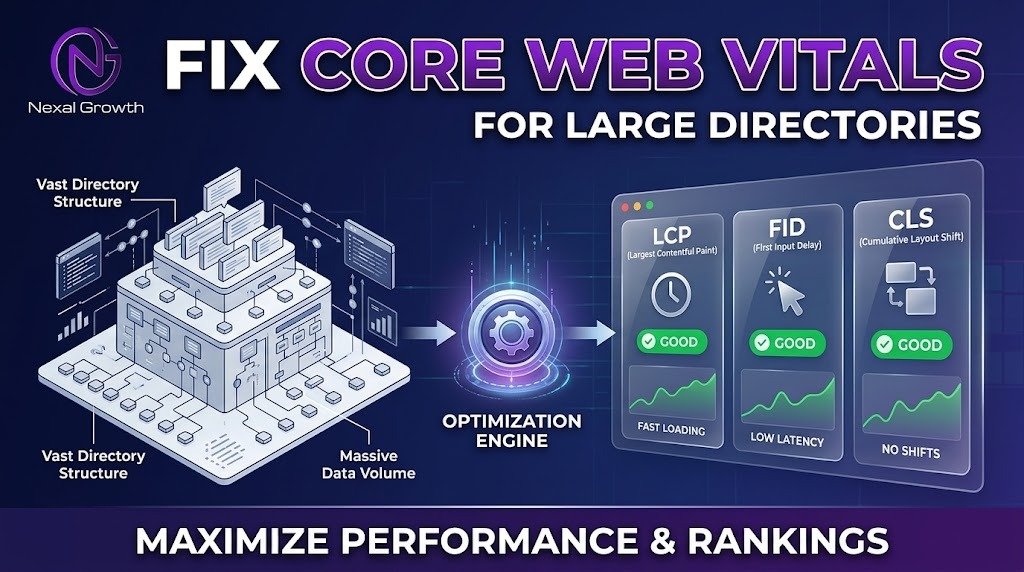
Hire core web vitals optimization service for large directories
Large directory websites bleed organic traffic and user retention when their database-heavy architecture fails Google’s Core Web Vitals (CWV) assessment.
Job boards, real estate aggregators, and local business directories face a unique set of technical hurdles that standard blogs never encounter. A directory relies on millions of programmatic pages, complex faceted search filters, and unpredictable user-generated content (UGC). When these elements drag page load times down, Google suppresses the domain’s search visibility in favor of faster, more stable competitors.
To pass the official assessment, a site must serve a Largest Contentful Paint (LCP) under 2.5 seconds, an Interaction to Next Paint (INP) under 200 milliseconds, and a Cumulative Layout Shift (CLS) below 0.1 for at least 75% of logged user sessions. Hitting these benchmarks across 500,000 dynamically generated URLs requires deep structural engineering, not a basic WordPress caching plugin.
At NexalGrowth.com, we engineer template-level performance fixes, optimize backend database query bottlenecks, and stabilize dynamic web layouts for enterprise-scale directories. We fix the root architectural issues causing poor performance to restore your organic search visibility and maximize user conversion.
Why Standard CWV Tactics Fail on Large Directory Sites
Standard web optimization advice is completely ineffective for a massive directory platform.
Generic page-caching plugins are designed for static articles, not dynamic inventory. Aggressive caching on a directory often breaks live inventory availability, dynamic pricing, localized maps, and logged-in user dashboard experiences.
You cannot manually optimize individual pages when dealing with scale. If your platform programmatically generates locations and categories (e.g., /plumbers-in-chicago/ or /3-bedroom-apartments-london/), optimization must happen at the server and global template level.
Furthermore, directories rely heavily on third-party scripts to monetize and function. Map APIs, header bidding ad networks, and behavioral tracking pixels actively block the browser’s main thread and destroy Core Web Vitals if not meticulously managed.
Conquering LCP on Location & Listing Pages
Largest Contentful Paint measures when the primary visual element of a page renders. On directory listing pages, this is usually a hero section pulling unoptimized, user-uploaded business logos or property photos.
Compounding this problem is slow server response times, formally known as Time to First Byte (TTFB). If the server takes two seconds to query the database, achieving a sub-2.5-second LCP is mathematically impossible.
Optimizing Database Queries & TTFB
We target TTFB by optimizing how your relational database indexes and retrieves information.
When a user requests a dynamic route, the server must pull location data, category parameters, and active listings simultaneously. We restructure these queries and implement object caching so dynamic routing retrieves payload data in milliseconds.
CDN-Level Image Optimization for UGC
User-generated content introduces massive unpredictability to your performance metrics. Businesses upload 8MB uncompressed images to their directory profiles, crippling the LCP score for that specific template.
We solve this by routing all UGC through dynamic Content Delivery Networks (CDNs). The CDN automatically intercepts heavy uploads, compresses them, and serves next-gen formats like WebP or AVIF based on the visiting user’s browser capabilities.
Preloading Critical Assets
For a location search result template, the browser must know exactly what to prioritize.
We implement advanced resource hinting to preload the exact hero image and primary text block in the DOM (Document Object Model). By instructing the browser to fetch the LCP element before executing heavy JavaScript, the perceived load time drops drastically.
Fixing INP on Complex Search & Filter Pages
Interaction to Next Paint measures how quickly a browser responds to a user’s click or keystroke. Faceted searches, like filtering by price, rating, or distance, are notorious for failing this metric.
When a user checks a filter box, poorly coded JavaScript forces the browser to freeze while it recalculates the entire page DOM.
Yielding the Main Thread for Map Modules
Interactive map modules (such as Google Maps or Mapbox) execute massive amounts of JavaScript upon loading.
We defer these map initializations until after the core page layout renders and yields the main browser thread. This ensures the page remains instantly interactive for users trying to click text links or open menus while the map finishes loading in the background.
Debouncing API Calls in Faceted Search
When users rapidly click multiple filter checkboxes on a directory, it triggers a flood of API requests that lock up the browser.
We implement JavaScript debouncing and throttling algorithms. This strategy groups rapid user inputs into a single delayed execution, preventing the browser thread from freezing and keeping your INP score safely under the 200ms threshold.
Managing Third-Party Scripts
Directories require analytics, live chat integrations, and monetization scripts.
We methodically delay all non-critical third-party scripts. By pushing execution until after user interaction (or delaying by several seconds), the browser prioritizes rendering the core directory UI and responding to the user’s initial input.
Eliminating CLS from Ads and Dynamic Grids
Cumulative Layout Shift occurs when elements move unexpectedly during page load. Directories rely heavily on programmatic ad revenue and asynchronous loading for infinite-scroll listings, which causes violent layout jumps.
A high CLS frustrates users who attempt to click a listing, only to have the layout shift and cause an accidental ad click instead.
Hardcoding Aspect Ratios for Ad Slots
Programmatic ads load unpredictably from header bidding auctions.
We write CSS architectures that reserve exact pixel dimensions for Google AdSense and third-party ad slots. By carving out a permanent, hardcoded container for the ad, the surrounding content remains perfectly stable even when the banner takes three seconds to render.
Stabilizing Grid Layouts
Infinite scroll and pagination grids often shift as text lengths and image sizes vary across different business listings.
We lock in the dimensions of business listing cards using modern CSS Grid and Flexbox parameters. This ensures that regardless of the data populating the card, the overall grid geometry remains rigid, guaranteeing a smooth scrolling experience.
The NexalGrowth Process: From Technical Audit to Deployment
Fixing enterprise-level directory platforms requires a precise, data-driven methodology to avoid disrupting live traffic.
Step 1: CrUX Data & Template Grouping
We do not waste time guessing. We extract 28-day historical data from the Chrome User Experience Report (CrUX) and Google Search Console. This isolates precisely which URL templates (e.g., category pages vs. individual business listings) are failing specific CWV metrics.
Step 2: Staging Environment Replication
Directory databases are highly complex and sensitive.
We duplicate your entire platform into an isolated, secure staging environment. This allows us to safely execute and test heavy structural changes to the database and code without risking user experience on the live site.
Step 3: Code Refactoring & Implementation
Our engineers rewrite bloated CSS and JavaScript directly within your theme or web application. We optimize server queries, implement resource hinting, and rebuild layout containers to meet Google’s exact technical specifications.
Step 4: Post-Deployment Monitoring
Core Web Vitals are evaluated on a rolling 28-day cycle based on real user data. After deployment, we monitor the CrUX dataset rigorously to validate that the technical fixes successfully translate to passing field scores for real-world visitors.
Why Choose NexalGrowth for Directory SEO?
We specialize in solving complex, structural SEO bottlenecks that generic agencies ignore.
Our team possesses deep expertise in technical site audits, algorithm penalty recovery, and advanced schema markup for local businesses. We understand how to navigate complex CMS environments, massive relational databases, and custom-built directory applications. We solve the root architectural causes of poor performance, rather than applying temporary patches that break under scale.
Stop Bleeding Organic Traffic—Request Your Technical Audit
Failing Google’s Core Web Vitals directly caps your organic search potential and frustrates your existing user base.
Stop losing traffic to faster, optimized competitors. Contact NexalGrowth.com today to request a comprehensive technical CWV audit for your directory. We will map the exact bottlenecks in your architecture and execute a precise, template-level roadmap to secure passing scores and scalable growth.



0 Comments
Leave a reply